Pressure-Treated vs. Cedar Wood Decking: Cost and Durability Trade-Offs
If you've already decided on a wood deck for your Ontario, California backyard, the next real decision is lumber. Most homeowners here narrow it down to pressure treated or cedar wood, and when choosing between cedar vs treated decking, the two behave differently in Inland Empire heat, cost differently up front, and age differently over 15 years. This guide walks you through the choice step by step, the way a local deck builder would explain it over the phone, so you can pick a species, understand what it means for your framing and your maintenance calendar, and get the deck built right the first time.
One quick note before the steps: wood is still a smart financial choice. According to the National Association of Realtors' 2023 Remodeling Impact Report, homeowners recover 89% of the cost of a new wood deck through added home value. So this is not a decision between a good option and a bad one. It is a decision between two good options with different trade-offs.
Step 1: Understand What Pressure Treated and Cedar Wood Actually Are
Start by clearing up the biggest point of confusion. Pressure treated lumber and cedar are not two versions of the same thing; they resist rot in completely different ways.
Pressure treated lumber is usually a softwood like pine or Douglas fir that gets forced full of preservative chemicals in a pressure chamber. The treatment protects it from rot, fungus, and termites from the inside out. It often has a greenish or brownish tint when new, and you'll also see "cedar-tone" pressure treated wood at lumber yards, which is treated pine stained to mimic cedar's color. That cedar-tone product is still pine, not cedar.
Cedar, by contrast, is naturally rot-resistant. The tree produces its own oils and tannins that repel insects and moisture, so it needs no chemical treatment. Which raises a question first-time deck planners ask constantly.
Cedar vs Treated Decking: Can You Buy Pressure Treated Cedar Wood?
No, pressure treated cedar wood is not a product you'll find at any lumber yard, because cedar is almost never pressure treated. Its natural oils resist the preservative process, and its built-in rot resistance makes treatment unnecessary. When a supplier lists "pressure treated cedar boards," they almost always mean cedar-tone treated pine, which is pine with a cedar-colored finish.
Knowing this protects you when you compare quotes. If one bid lists "cedar" decking at a price far below another bid's cedar line item, ask whether it is true Western Red Cedar or cedar-tone treated lumber. The two are not interchangeable, and the price difference is real.
Step 2: Compare the Cost of Pressure Treated and Cedar Wood Decking
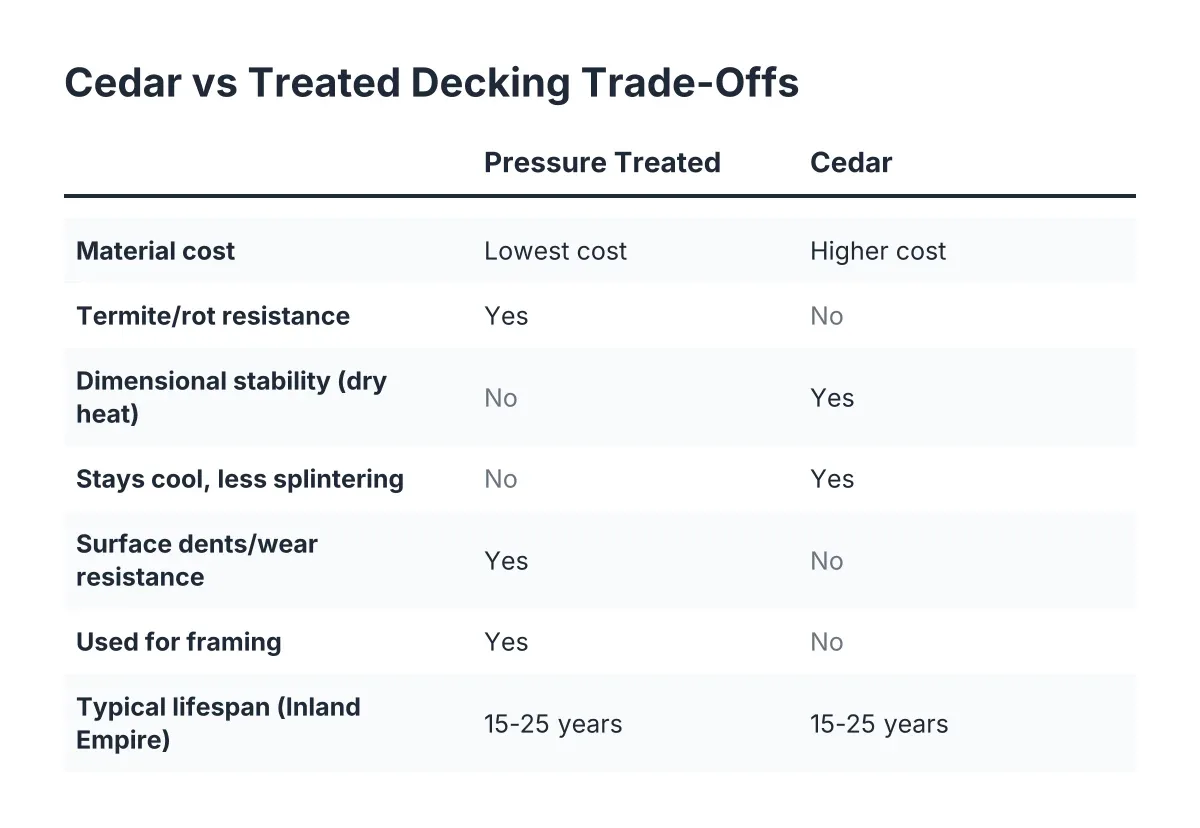
Is pressure treated wood cheaper than cedar? Yes, in nearly every case. Pressure treated pine is the least expensive structural decking lumber sold in Southern California, while true cedar typically runs noticeably higher for the deck boards alone. For a first-time deck planner budgeting a full backyard project, that gap matters most on larger decks.
Here is how the cost picture usually breaks down for a wood deck in the Inland Empire:
- Pressure treated decking: Lowest material cost. Standard sizes like deck boards 16 ft long are stocked everywhere, which keeps waste and pricing down on common deck layouts.
- Cedar decking: Higher material cost, often meaningfully so, because true cedar is shipped in from the Pacific Northwest rather than milled locally.
- Framing: Almost always pressure treated regardless of what goes on top. Code and common sense both point to treated lumber for joists, beams, and posts that sit near soil and sprinkler spray.
- Labor: Roughly similar for both species. Cutting and fastening cedar is not dramatically slower than treated pine.
For context on the alternative you may have already ruled out, composite runs $25 to $54 per square foot professionally installed, according to Angi. Both wood options typically land below that installed range, which is a big reason homeowners with an $8,000 to $30,000 budget often get more square footage from wood deck construction than from a Trex deck material or other composite build.
Say a homeowner in Rancho Cucamonga is pricing a 300-square-foot attached deck in 2026. In that illustrative scenario, going from pressure treated to cedar decking might add a few thousand dollars in materials alone. Whether that premium is worth it comes down to the next two steps.
Step 3: Weigh Durability in the Inland Empire Climate
Our climate changes the usual advice. Most of the pressure treated versus cedar articles online are written for wet, cold regions. Ontario, California gets intense sun, dry summers, Santa Ana winds, and only modest rain. That shifts the durability math.
Pressure treated lumber's main advantage is rot and termite resistance, and termites are a genuine concern in San Bernardino County and Riverside County. Treated lumber shrugs them off. Its weakness is movement: treated boards arrive wet from the treatment process, and in our dry heat they can shrink, cup, twist, and check (crack along the grain) as they dry out fast. Good builders manage this with careful board selection, correct gapping, and fastening patterns that hold boards flat, but some movement is normal in the first year.
Cedar is more dimensionally stable. It arrives drier, moves less, stays cooler underfoot, and does not splinter as readily, which matters if kids will be running around barefoot in July. Its weakness is surface wear: cedar is a soft wood, so furniture legs, dog claws, and heavy traffic dent it more easily. Direct Inland Empire sun also bleaches unsealed cedar to gray within a season or two.
With honest maintenance, expect a wood deck lifespan in the range of 15 to 25 years for either species here, with treated lumber often edging out cedar on raw longevity and cedar winning on appearance along the way. For perspective on why build quality matters, the North American Deck and Railing Association estimates that about 50 percent of the roughly 50 million decks in the U.S. are more than 25 years old, which is exactly why footings, flashing, and fastening done right at install time pay off for decades.
Step 4: Match the Species to How You'll Use the Deck
Next, make the call based on your actual backyard plans rather than a generic pros-and-cons list. A few honest guidelines from how these decks get used across Ontario, Chino, Fontana, and Upland:
- Choose pressure treated if budget rules. You get the most deck for the dollar, and with a quality cedar stain or solid-color finish, treated pine can look sharp. Pressure treated wood with a cedar stain is one of the most common finishes on new wood decks in the area.
- Choose cedar if the deck is a showpiece. If this deck anchors a new backyard and you want the natural grain, warm color, and that cedar smell, treated pine won't fully imitate it, even cedar-tone boards.
- Choose cedar for barefoot comfort. It runs cooler in direct sun and splinters less, which matters on a south-facing deck with no shade cover yet.
- Choose pressure treated for ground-contact and structure. Stair stringers, posts, beams, and any board near soil or sprinklers should be treated lumber no matter what the deck surface is.
Many of the best wood decks use both: a pressure treated frame with cedar deck boards and cedar deck railing on top. You put the chemical rot resistance where moisture and termites attack, and the good looks where people see and touch the deck. This hybrid approach is standard practice for a reason.
Step 5: Plan the Maintenance Before the First Board Goes Down
Whichever species you choose, commit to a care routine now, because wood only outperforms its reputation when it gets sealed. Here is the realistic schedule for an Inland Empire wood deck:
- Pressure treated: Let new boards dry for a few months, then stain and seal. Re-coat about every 2 to 3 years. Skipping this invites cracking and graying in our sun.
- Cedar: Seal with a UV-protective finish soon after installation, then re-coat every 1 to 3 years depending on sun exposure. Unprotected cedar grays fast here.
- Both: Rinse off debris seasonally, keep sprinklers from hitting the deck daily, and check fasteners and railing connections once a year.
If recoating a deck every couple of years sounds like a chore you will skip, be honest with yourself at this stage. That is the one scenario where composite decking deserves a second look before you commit to wood, since its whole appeal is trading higher upfront deck cost for lower maintenance.
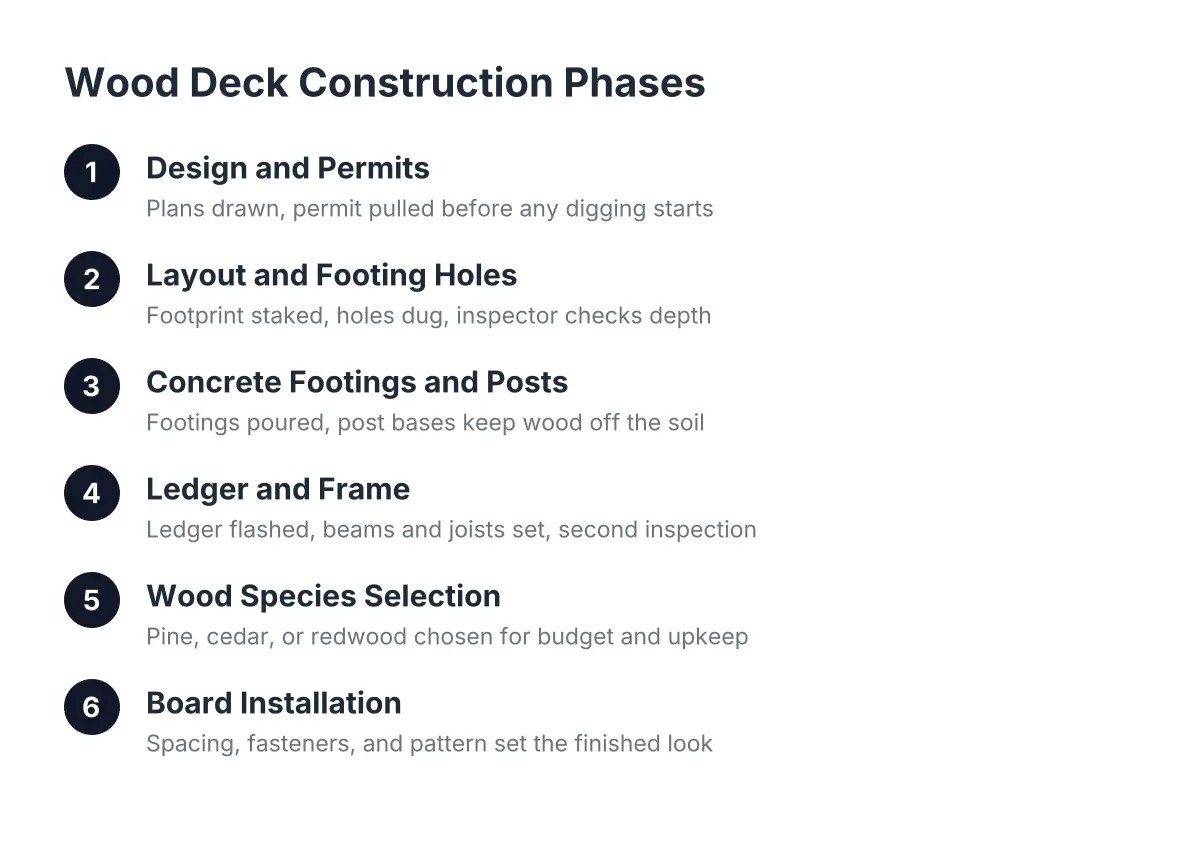
Step 6: Confirm Permits, Code, and Structural Details With Your Builder
Finally, lock down the paperwork and structural plan before any lumber gets ordered. Ontario, California requires permits for most deck construction, and inspectors check footing depth, post connections, ledger attachment, and railing height. A deck building permit typically costs between $230 and $500 depending on location, according to HomeAdvisor, so build that into your budget rather than discovering it mid-project.
Ask your deck builder these questions on the first call:
- Who pulls the permit, you or me, and is that cost in the quote?
- Is the framing pressure treated and rated for ground contact where needed?
- What fasteners are you using? Treated lumber's chemicals corrode standard screws, so code calls for hot-dipped galvanized or stainless hardware.
- How will you handle flashing where the deck attaches to the house?
- What finish do you recommend for this species in full sun, and when should the first coat go on?
A builder who answers those questions plainly is a builder who has done this on local soil, in local heat, under local code. One honest caveat: if your site has a slope, questionable soil, or an elevated design, have a professional evaluate the footing and framing plan rather than relying on any article, including this one. Species choice is the easy part; the structure underneath is where decks succeed or fail.
Get the species decision made with steps 1 through 4, the maintenance commitment made in step 5, and the right questions asked in step 6, and you will walk into your first builder conversation sounding like someone who has done this before.
If you need custom deck design, Inland Empire Decks can help.
Prefer to talk it through? Call (909) 298-8578 — a quick call is usually the fastest way to get a straight answer for your situation.