Deck Railing Installation — Complete Guide
Deck railing installation shapes how your deck looks, how safe it feels, and whether it passes inspection in San Bernardino County. If you are planning a new deck or staring at a wobbly railing on an older one, this guide walks you through the decisions that matter: material choices, California code requirements, cost expectations, and replacement options. We build decks across Ontario, California and the Inland Empire, so the deck railing ideas here come from real installs on real Southern California homes. By the end, you will know which railing style fits your deck, what the code demands, and when a repair beats a full replacement.
What You'll Find in This Guide
- How Much Does Deck Railing Installation Cost?
- Composite Deck Installation in Ontario, CA
- Deck Installation in Ontario, CA
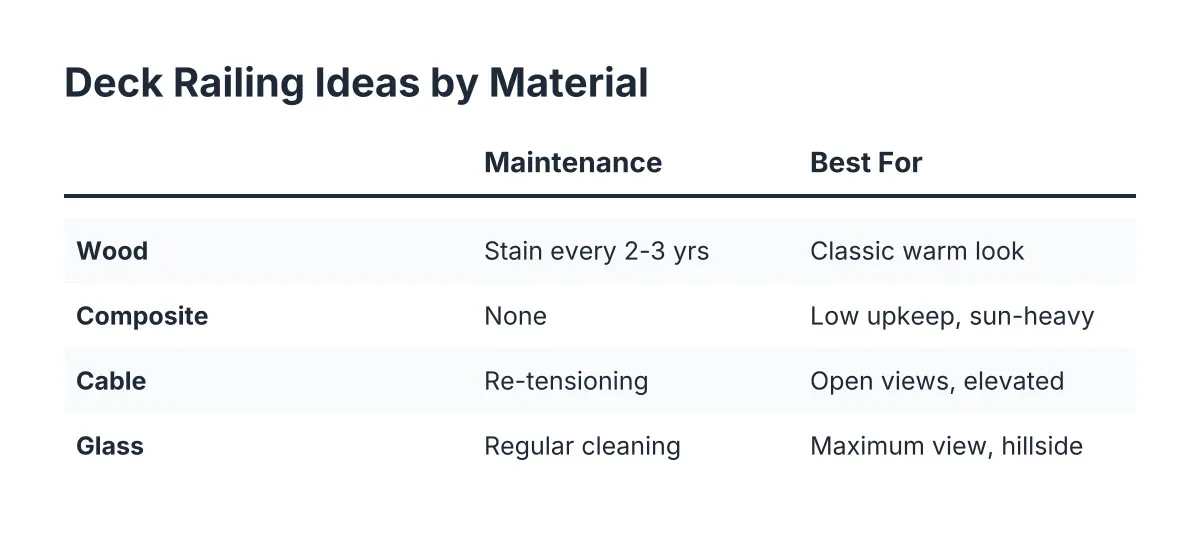
Deck Railing Ideas by Material: Wood, Composite, Cable, and Glass
Material choice drives everything else. It sets your budget, your maintenance schedule, and the entire look of your deck. In practice, most Inland Empire homeowners choose between four options: wood, composite, cable, and glass panel systems. Each one behaves differently under Southern California sun, so the right pick depends on your deck, your view, and your tolerance for upkeep.
Wood railing remains the most affordable option upfront. It pairs naturally with wood deck construction, and you can stain it any color you want. However, wood demands the most maintenance. Ontario, California summers bake unsealed wood, and dry heat opens cracks faster than most homeowners expect. If you choose wood, plan on staining and sealing every couple of years to keep it safe and attractive.
Composite railing skips that maintenance cycle almost entirely. It resists fading, never needs stain, and matches the composite decking we install across Rancho Cucamonga, Fontana, and Upland. The market reflects that appeal. According to Grand View Research, the global composite railing and decking market reached $4.7 billion in 2025 and is projected to hit $12.6 billion by 2033. That growth means more composite deck railing options every year, from classic white balusters to modern flat-top profiles. If low maintenance sounds right for you, our composite deck installation page shows how we build these systems locally.
Cable and Glass: Railings That Protect the View
Cable railing has become the go-to choice for elevated decks with a view. Thin stainless steel cables run horizontally between posts, so your sightline stays open. When homeowners ask about cable railing vs wood railing, the tradeoff is simple: cable costs more upfront but preserves the view and needs less maintenance. Wood costs less at install but blocks more of what you built the deck to see.
Glass panel deck railing takes view preservation even further. Tempered glass panels create a nearly invisible barrier, which works beautifully on multi-level and hillside decks in Riverside and Corona. That said, glass costs the most of the four options, and it needs occasional cleaning to stay clear. For a full pricing comparison across all these materials, see our guide to deck railing installation cost.
California Deck Railing Code Requirements Every Homeowner Should Know
Railing is not just a design decision. It is a safety system, and California regulates it for good reason. Before you fall in love with a style, make sure it can meet code. Otherwise, you risk a failed inspection and an expensive redo.
The height requirement comes first. The California Building Code requires a minimum guardrail height of 42 inches for most residential decks that sit more than 30 inches above grade, according to the California Building Standards Commission. This catches many first-time deck planners off guard, because the widely cited national standard is 36 inches. California sets the bar higher. As a result, railing kits sized for other states may not pass inspection in San Bernardino County or Riverside County. You can review the current codes directly through the California Building Standards Commission.
Spacing rules matter just as much. Balusters and infill cannot allow a 4-inch sphere to pass through at any point. This rule protects small children from slipping through or getting stuck. For cable railing, that means proper cable tension and spacing, since loose cables can spread wider than 4 inches under pressure. Consequently, cable systems demand precise installation, not just good hardware.
Why Older Decks Often Fail Railing Inspections
Age is the hidden factor in railing safety. According to the North American Deck and Railing Association, an estimated 50 percent of the roughly 50 million decks in the U.S. are more than 25 years old. Many of those decks carry railings built to older codes, or railings that have simply loosened over decades of use. If your Ontario, California home came with an existing deck, the railing may predate current requirements entirely.
Beyond code, connection quality determines whether a railing actually holds. A railing must resist a strong outward push at the top rail. In practice, that strength comes from how the posts attach to the deck framing, not from the rails themselves. This is why we address railing attachment during deck framing on every deck installation we build. A post bolted through solid blocking will hold for decades. A post surface-screwed to a single deck board will not.
Repair, Replace, or Upgrade: Choosing the Right Path for Your Railing
Not every railing problem requires a full replacement. However, some problems absolutely do. Knowing the difference saves you money on one end and protects your family on the other. Here is how we think through it on Inland Empire decks.
Start with the wobble test. Grab the top rail and push outward with real force. If the railing flexes at the posts, you have a connection problem, not necessarily a material problem. Replacing a wobbly deck railing often means rebuilding the post connections with through-bolts and blocking rather than swapping every component. That said, if the posts themselves show rot, cracking, or rusted fasteners, patching the connection only delays the inevitable. Rotted posts need replacement, full stop.
Next, consider the deck underneath. A railing is only as strong as the framing it attaches to. For example, if your deck boards are cupping and the joists show water damage, installing a new railing on that structure wastes money. In those cases, a deck resurfacing or full deck replacement makes more sense, and the new railing gets built into a sound frame from the start.
When an Upgrade Makes More Sense Than a Repair
Sometimes the railing is structurally fine but visually dated. Chunky pressure-treated wood railings from the 1990s can make an otherwise solid deck feel old. Swapping to composite, cable, or glass transforms the whole space without rebuilding the deck. Additionally, an upgrade is the natural moment to fix code gaps, like bringing a 36-inch railing up to California's 42-inch requirement.
Budget drives the final call. Deck railing cost varies widely by material, so a wood-to-wood replacement might run a fraction of a glass panel upgrade. Length matters too, since a wraparound deck needs far more linear feet than a simple rectangle. Our deck railing installation cost guide breaks down pricing by material and project size, so you can compare a repair against an upgrade with actual numbers. With this in mind, get the structure evaluated first, then choose the deck railing ideas that fit both your budget and your inspection requirements.
Matching Railing Style to Your Deck Type and Neighborhood
The best railing choice depends on the deck it sits on. We build attached decks, freestanding decks, elevated decks, and multi-level decks across Ontario, Rancho Cucamonga, Chino, and Upland. Each type points toward different deck railing ideas, and getting that match right makes the finished project feel intentional.
Ground-level and attached decks give you the most freedom. Since fall height is minimal, some low decks under 30 inches do not require a guardrail at all under California code. Even so, many homeowners add one for definition and seating support. On these decks, style leads the decision. A simple composite or wood railing frames the space nicely, and budget stretches further because the stakes are lower.
Elevated and multi-level decks flip the priorities. Here, the railing is a life-safety system first and a design element second. Post connections, code height, and infill spacing become non-negotiable. At the same time, elevated decks are exactly where view-preserving options shine. Cable and glass panel railings earn their higher price on a second-story deck overlooking the San Gabriel foothills. For these builds, we plan the railing during the framing stage so the posts tie directly into the structure.
Climate and Curb Appeal Considerations for Inland Empire Homes
Southern California climate shapes material performance more than most homeowners realize. Intense UV exposure fades cheap vinyl and dries out unsealed wood. Meanwhile, composite and powder-coated aluminum handle Ontario, California summers with minimal change year over year. North America already leads the world in composite adoption, holding a 29.2% revenue share of the global composite railing and decking market in 2025 according to Grand View Research, and hot-climate durability is a big part of why.
Finally, think about how the railing reads from the street and the yard. A railing is one of the most visible parts of your home's exterior. Matching its color and profile to your trim, patio cover, or fencing pulls the whole property together. If you are starting from scratch, our team designs the railing alongside the deck itself as part of every deck installation in Ontario, CA, so the two never feel like separate projects.
Ready to Get Started?
If you are weighing railing materials, worried about a wobbly railing, or planning a new deck from the ground up, we can help you sort the options against California code and your budget. Our crew designs and installs deck railings across Ontario, California and the Inland Empire, from Rancho Cucamonga to Riverside. Reach out for a free on-site assessment and get railing recommendations built for your deck, not a generic checklist.