
Deck Building Timeline — Complete Guide
Planning a new deck and wondering how long the whole process actually takes? This guide walks you through a realistic deck building timeline for homeowners in Ontario, California and across the Inland Empire, from the first design consultation to the final walkthrough. Instead of vague national averages, you'll get stage-by-stage estimates grounded in how San Bernardino County and Riverside County permitting actually works. You'll also learn which factors speed a project up, which ones stall it, and what you can do at each stage to keep your build on schedule. By the end, you'll know exactly what to expect week by week, so nothing about your project catches you off guard.
What You'll Find in This Guide
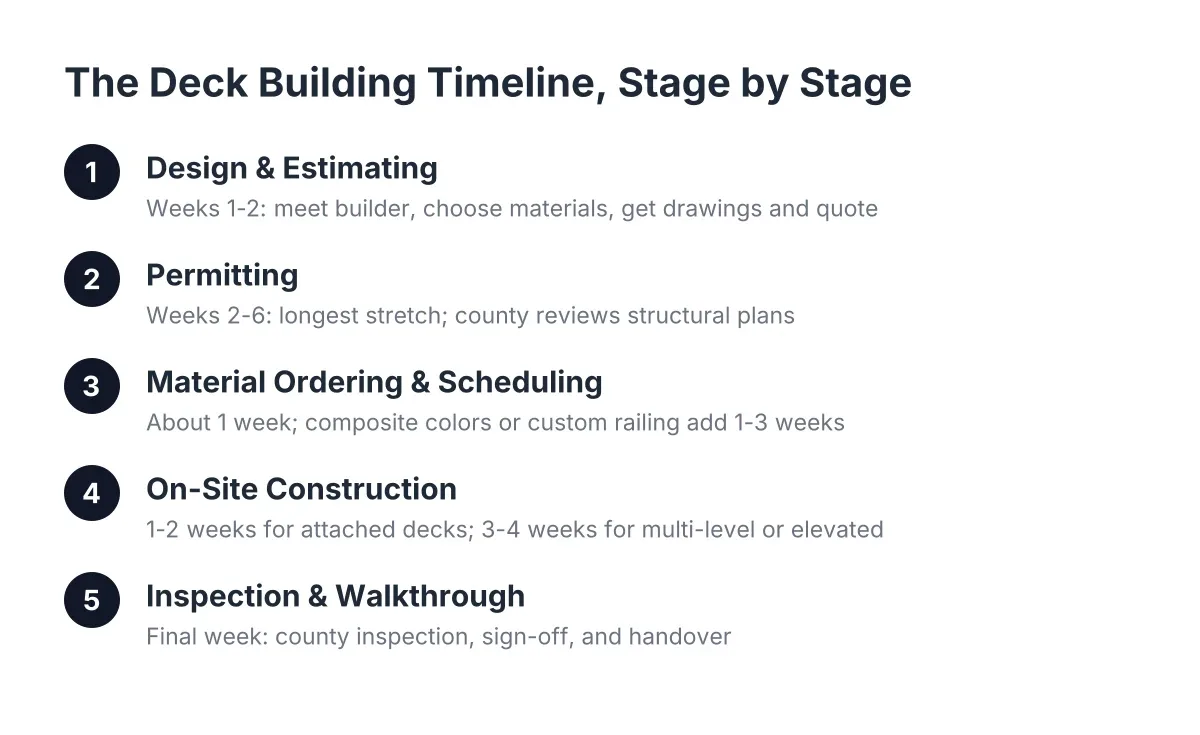
The Deck Building Timeline, Stage by Stage
Most custom deck projects in the Inland Empire take six to ten weeks from first phone call to final walkthrough. That range surprises a lot of first-time deck planners, because the actual construction is often the shortest part. In practice, design and permitting eat up more calendar time than swinging hammers ever does. Here's how the stages typically break down for a project in Ontario, California or nearby cities like Rancho Cucamonga, Fontana, and Upland.
Weeks 1–2: Design Consultation and Site Assessment
Your timeline starts with an on-site consultation. A designer measures your yard, checks grade and drainage, and looks at how your home's structure will support an attached deck. During this stage, you'll make the decisions that shape everything downstream: composite or wood, attached or freestanding, single level or multi-level. Additionally, this is when you'll lock in a budget range. If you're still weighing options, our guide on how much deck building costs walks through the pricing factors before you commit to a design.
Expect one or two design revisions here. Each revision typically adds three to five days, so decisive homeowners move through this stage fastest.
Weeks 2–5: Permits and Plan Approval
Once you approve the design, your builder submits plans to the local building department. In Ontario, California, that means the city's building division; in unincorporated areas, it means San Bernardino County or Riverside County. This stage carries the widest variance in any deck building timeline, and we cover it in detail in the next section.
Weeks 5–8: Construction
With permits in hand, actual construction moves quickly. Footings and posts go in first, followed by framing, decking, railings, and stairs. A straightforward 300-square-foot ground-level deck often takes one to two weeks of build time. However, elevated decks, multi-level designs, and complex railing systems can stretch construction to three weeks or more.
Final Week: Inspections and Walkthrough
Your project ends with a final inspection from the city or county, then a walkthrough with your builder. You'll review every detail, from board spacing to railing stability, before signing off. As a result, you close out the project with a permitted, code-compliant deck and documentation that protects your home's value at resale.
Permit Approval and Deck Building Timeline in San Bernardino and Riverside Counties
Permitting is where generic national timelines fall apart, and it's where Inland Empire homeowners most often get blindsided. National articles love to say "permits take a few days." That may hold in small rural towns. In Southern California, it rarely does.
What the Permit Process Actually Involves
Before anyone digs a footing, your plans need review for structural soundness, setback compliance, and code adherence. In Ontario, California, deck plans go through the city's building division, which checks them against the California Building Code and local zoning rules. For example, an elevated deck attached to your home faces more scrutiny than a low freestanding platform, because ledger connections and guardrail heights carry real safety stakes.
Plan check turnaround in San Bernardino County and Riverside County jurisdictions commonly runs two to four weeks for a residential deck. However, corrections can extend that. If a plan checker flags a missing detail, such as footing depth or lateral load connections, your builder revises and resubmits. Each correction cycle adds one to two weeks. This means that a clean, complete first submission is the single biggest thing your builder can do to protect your schedule.
Budget matters here too. According to HomeAdvisor, a deck building permit typically costs between $230 and $500 depending on location. That fee is small compared to your total project cost, and it buys you inspections that verify your deck is safe. If your property sits in an unincorporated area, you can check requirements directly through San Bernardino County Land Use Services, which handles permitting outside city limits.
Why You Should Never Skip the Permit
Some homeowners ask whether they can build without a permit to save time. The short answer: don't. Unpermitted decks create problems at sale, complicate insurance claims, and skip the inspections that catch dangerous framing errors. Beyond that, an experienced local builder already knows what Ontario, Rancho Cucamonga, Corona, and Riverside plan checkers look for. In practice, that local knowledge shaves weeks off your deck building timeline compared to a contractor who learns each city's quirks on your dime.
What Delays a Deck Build, and How to Prevent It
Even a well-planned project can slip. That said, most delays are predictable, and you can prevent the majority of them with a few smart decisions early on. Here are the schedule killers we see most often across the Inland Empire, along with what to do about each one.
Design Indecision and Change Orders
The most common delay doesn't come from permits or weather. It comes from homeowners changing their minds mid-project. Switching from wood to composite after plans are submitted means new structural calculations and a resubmission to the building department. Similarly, adding a level or moving stairs during construction triggers a revised permit. To avoid this, spend real time on the design phase. Look at material samples in your actual yard. Additionally, settle your budget before plans go to the city, so cost surprises don't force late changes. Our deck cost guide helps you get those numbers right the first time.
Material Availability
Standard pressure-treated lumber and popular composite lines usually ship within days. However, specialty railing systems, exotic hardwoods, and custom-order composite colors can carry lead times of two to six weeks. If your heart is set on a specific product, order it during the permit review window. That way, materials arrive while the city reviews your plans, and neither wait adds to your total timeline for building your deck.
Weather and Seasonal Demand
Ontario, California enjoys one of the best building climates in the country. Even so, winter rain can pause concrete footing work, since footings need dry conditions to cure properly. Summer brings a different constraint: peak demand. Builders across San Bernardino County and Riverside County book up from late spring through early fall. As a result, starting your design consultation in winter or early spring often means faster scheduling and a finished deck before summer barbecue season.
Inspection Scheduling
Your build requires inspections at key milestones, typically at footings, framing, and final completion. Inspectors book out several days in most Inland Empire cities. For example, if your builder pours footings on a Friday but can't get an inspection until Wednesday, framing waits. An organized builder schedules inspections in advance and sequences work around them, keeping dead days off your calendar.
Repair, Resurface, or Replace: How Your Starting Point Changes the Schedule
Not every project starts from bare dirt. If you already have a deck, your timeline depends heavily on its condition, and the right scope of work can save you weeks or cost you weeks.
When Repair or Resurfacing Makes Sense
If your deck's frame is structurally sound but the surface looks tired, resurfacing offers the fastest path to a like-new deck. Your builder keeps the existing footings, posts, and joists, then replaces the deck boards and railings. In practice, a resurfacing project often wraps in under a week, and many jurisdictions treat it differently than new construction for permitting purposes. Similarly, targeted repairs like replacing damaged boards or reinforcing a railing can finish in a day or two.
Age matters more than appearance, though. According to the North American Deck and Railing Association, an estimated 30 million of the more than 60 million decks in the U.S. are past their useful life and need replacement or repair. A deck built in the 1990s may look serviceable while hiding corroded fasteners, rotted ledger connections, or footings that no longer meet code. With this in mind, always get a structural assessment before choosing resurfacing over replacement. Putting new boards on a failing frame wastes money and delays the inevitable.
When Full Replacement Is the Right Call
Full replacement follows essentially the same schedule as new construction: design, permits, demolition, and build. Demolition adds only a day or two, so expect a similar six-to-ten-week window overall. However, replacement carries advantages a first-time build doesn't. Your yard already accommodates a deck, utility locations are known, and you have real experience with what you liked and disliked about the old layout.
The investment tends to hold its value, too. The National Association of Realtors' 2023 Remodeling Impact Report found homeowners recover 89% of the cost of a new wood deck through added home value. For Inland Empire homeowners weighing a tired old deck against a new one, that math makes replacement easier to justify. To put it simply, know your deck's true condition first, then match the scope of work and the timeline to reality rather than guesswork.
Ready to Get Started?
If you're planning a deck in Ontario, California or anywhere in the Inland Empire, the best time to start is before you need it finished. Our team handles design, San Bernardino County and Riverside County permitting, and construction under one roof, so your project moves without handoff delays. Reach out for a free consultation and get a realistic, date-specific timeline for your yard.