Deck Replacement Terms Explained: A Plain-English Glossary
If you are getting quotes for a new deck in Ontario, CA, the paperwork can read like a foreign language. This deck replacement glossary breaks down the terms you will meet in estimates, permit talk, and conversations with a deck builder across the Inland Empire. Each entry starts with a plain definition you can use on its own, then tells you why the term matters to your project and your wallet. Read it before your next quote and you will know exactly what you are paying for.
- Deck Replacement: tearing out the old, building new
- Deck Resurfacing: new boards, same frame
- Deck Repair: fixing one problem, not the whole deck
- Tear-Off and Demolition: removing and hauling away the old deck
- Deck Framing: the structure under your feet
- Ledger Board: where the deck attaches to the house
- Footings and Posts: the deck's foundation
- Joists: the boards that hold up the decking
- Attached vs. Freestanding Deck: connected to the house or standing alone
- Composite Decking: low-maintenance boards made from wood and plastic
- Pressure-Treated Lumber: wood treated to resist rot and insects
- Deck Railing: the safety barrier around the edges
- Flashing: the metal that keeps water out of your house
- Building Permit: the city's sign-off on your project
- Inspection: the city checking the work at key stages
- Load Capacity: how much weight the deck can safely hold
- Scope of Work: the written list of what the contractor will do
- Change Order: a written update when the plan changes mid-project
Deck Replacement, Resurfacing, and Repair: The Big Three
These first terms in the deck replacement glossary matter most, because contractors use them to describe three different projects at three different price levels.
Understanding Deck Replacement
Deck replacement means removing an existing deck entirely and building a new one in its place, usually including a new frame, footings, decking, and railing. It is the right call when the structure underneath has rotted, the footings have shifted, or the old deck was never built to current safety standards. Because it starts from scratch, it costs more than resurfacing but gives you a deck with a full lifespan ahead of it. If a contractor recommends it, ask them to show you the specific damage that rules out a lighter fix. For a breakdown of what drives the price, see How Much Does Deck Replacement Cost?
Deck Resurfacing
Deck resurfacing means replacing the walking surface and often the railing while keeping the original frame underneath. It only works if the frame, posts, and footings are still sound, which a good deck builder will verify before quoting. Resurfacing costs less than a full rebuild because the structural work is already done. Be cautious of anyone who offers to resurface without crawling under the deck first. New boards on a rotten frame is money wasted.
Deck Repair
Deck repair means fixing a specific problem, such as a cracked board, a loose railing, or a soft spot, without rebuilding the deck. It is the cheapest option when the damage is isolated. The catch is that widespread rot or insect damage rarely stays isolated, so repairs can become a treadmill. A straightforward contractor will tell you when repair stops making sense and replacement becomes the better spend.
Tear-Off and Demolition
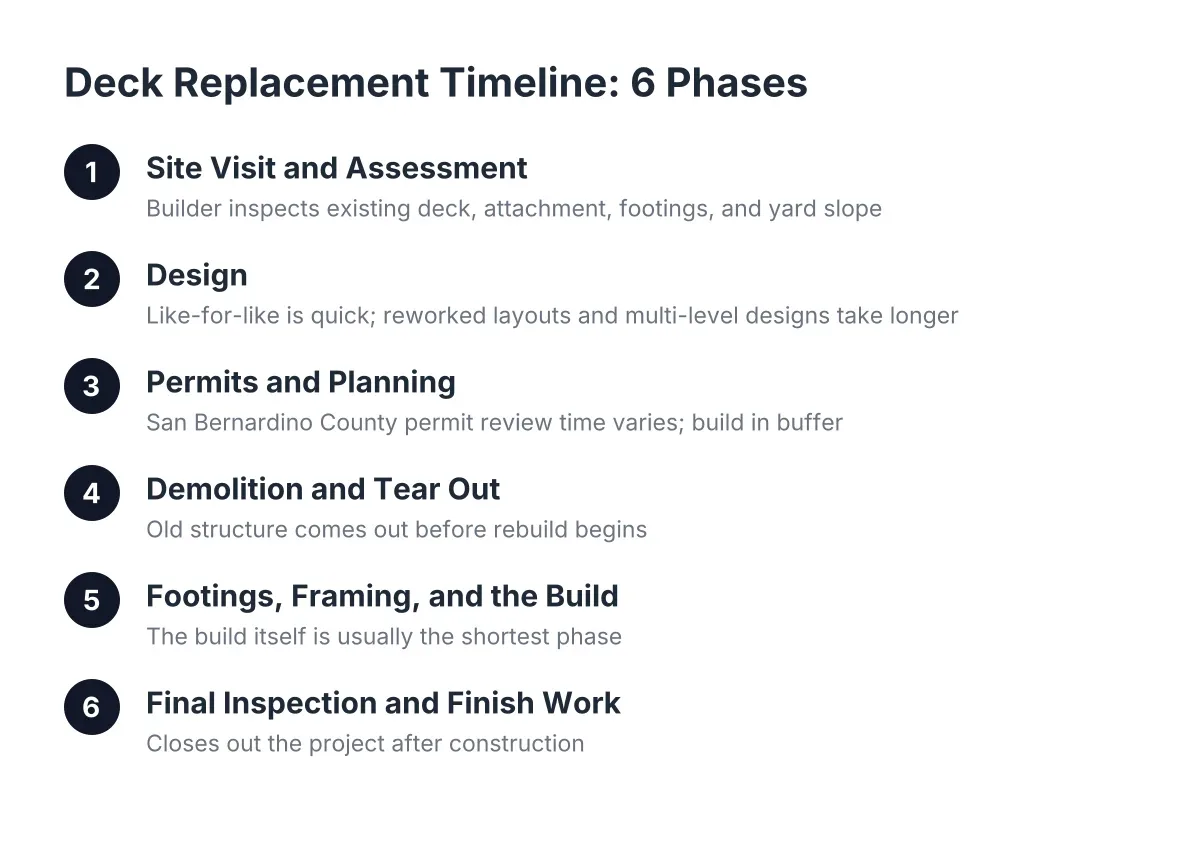
Tear-off is the removal and disposal of your old deck before the new one goes up. It includes pulling the decking, frame, and often the old footings, then hauling the debris away. Demolition and disposal fees should appear as their own line on a deck replacement quote, so check that yours does. If it is missing, ask whether removal is included or whether you will be billed for it later.
Structure: What Holds Your Deck Up
Deck Framing
Deck framing is the skeleton of the deck, the network of posts, beams, and joists that carries all the weight. You never see most of it once the deck boards go on, which is why frame condition decides whether you need deck replacement or just a new surface. When a builder quotes framing, ask what lumber they use and how they protect it from moisture. In Southern California heat, dried-out and cracked framing is as common a problem as rot.
Ledger Board
A ledger board is the horizontal piece of lumber that attaches a deck to the side of your house. It carries a large share of the deck's weight, so a ledger that is poorly fastened or lets water in behind it is one of the most common causes of deck failure. During a replacement, the builder should inspect the wall behind the old ledger for hidden rot. A contractor who talks about ledger flashing and proper fasteners is paying attention to the right things.
Footings and Posts
Footings are the concrete bases set in the ground that support the deck's vertical posts. They transfer the deck's weight into the soil, so their size and depth must match the deck's load and local soil conditions. Here in San Bernardino County and Riverside County, your city will have requirements for footing depth, which is one reason permits matter. New footings are standard in a full deck replacement; reusing old ones is only safe if an inspection confirms they are sound.
Joists
Joists are the repeating horizontal boards that sit on the beams and directly support the deck boards you walk on. Their spacing matters: composite decking often requires joists set closer together than wood decking does. If you are switching from wood to composite, ask whether the existing joist spacing works or whether the frame needs changes. Sagging or bouncy spots on an old deck usually trace back to tired joists.
Attached vs. Freestanding Deck
An attached deck connects to your house through a ledger board, while a freestanding deck stands on its own posts and footings with no connection to the structure. Attached decks save on posts but demand careful flashing where they meet the house. Freestanding decks avoid that risk and can be a smart choice when the house wall is not suited for a ledger. Your deck builder should explain which design fits your home and why, since it affects both the permit and the price.
Materials and Finishes
Composite Decking
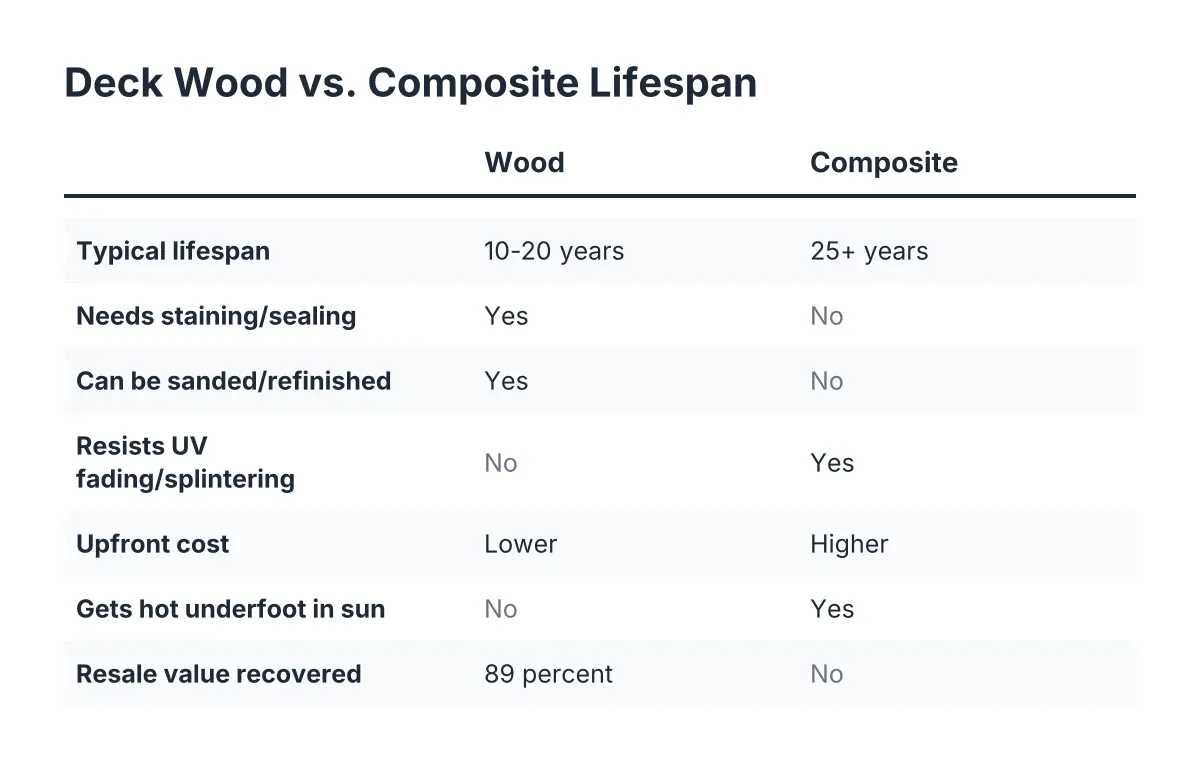
Composite decking is a board made from a blend of wood fibers and plastic, designed to resist fading, splintering, and rot without staining or sealing. It costs more upfront than wood but cuts ongoing maintenance to washing. In the Inland Empire, where strong sun beats on a deck most of the year, composite's fade resistance is a real advantage. Ask any installer how they handle expansion gaps, since composite boards move with temperature changes.
Pressure-Treated Lumber
Pressure-treated lumber is wood that has preservatives forced deep into it under pressure, making it resist rot and insects. It is the standard material for deck framing even under composite decks, and a budget-friendly choice for the deck surface itself. Treated wood still needs staining and sealing every few years to hold up to Ontario, California sun. If a quote lists untreated lumber for ground-contact framing, that is a red flag worth questioning.
Deck Railing
A deck railing is the barrier around the open edges of a deck that keeps people from falling off. Local building codes set minimum railing heights and limit the gaps between pickets, and the city inspector will check both. Railing material, wood, composite, or metal, is one of the bigger style and cost decisions in a new deck. Make sure your quote states the railing type instead of a vague line like "railing included."
Flashing
Flashing is the thin metal or waterproof membrane installed where the deck meets your house, directing water away from the ledger board and the wall. Missing or failed flashing is a leading cause of hidden rot inside house walls. It is cheap to install during construction and expensive to fix after the fact. Ask your deck builder to describe their flashing detail; a confident, specific answer is a good sign.
Paperwork, Permits, and Pricing
Building Permit
A building permit is official approval from your city to build or replace a structure like a deck. In Ontario, CA and nearby cities such as Rancho Cucamonga, Upland, and Chino, decks above a certain size or height typically need one; your city's building department sets the rules. Permits trigger inspections, which protect you by confirming the work meets code. A contractor who offers to skip the permit is shifting risk onto you, including problems when you sell the house.
Inspection
An inspection is a visit from a city building official who checks the work at set stages, often after footings are dug and again when the deck is complete. Passing inspections means an independent set of eyes confirmed the structure is safe. Your contractor should schedule and attend these, and the cost of permit fees should be spelled out in your quote. Keep the final sign-off paperwork; future buyers of your home may ask for it.
Load Capacity
Load capacity is the amount of weight a deck is designed to safely carry, including people, furniture, and anything heavy like a hot tub or planters. Building codes set minimum design loads, and footing size, post spacing, and joist dimensions all flow from that number. If you plan to add a hot tub or an outdoor kitchen, tell your deck builder before design starts. Upgrading capacity later means rebuilding structure, not just adding boards.
Scope of Work
A scope of work is the written section of your contract that lists exactly what the contractor will do, from demolition through final cleanup. A clear scope names materials, dimensions, railing type, permit responsibility, and debris disposal. Vague scopes are where disputes are born, because "build new deck" can mean almost anything. Compare scopes line by line when you collect quotes; the lowest price often hides the thinnest scope.
Change Order
A change order is a written agreement that updates the contract when something changes mid-project, such as hidden rot found during tear-off or a material upgrade you request. It states the new work and the new cost before that work happens. Good contractors use change orders for every change, no matter how small. Verbal "we'll sort it out later" arrangements are how surprise bills appear at the end of a job.
Using These Terms
You now have what this deck replacement glossary is built to give you: the vocabulary to read a quote line by line and know what each item means for safety, scope, and cost. When a deck builder mentions footings, flashing, or a change order, you can ask sharper follow-up questions instead of nodding along. That knowledge is the difference between buying a deck and buying a line item you do not understand.
If you need custom deck design, Inland Empire Decks can help.
Prefer to talk it through? Call (909) 298-8578 — a quick call is usually the fastest way to get a straight answer for your situation.