Composite Decking Materials Terms Explained: A Plain-English Glossary
If you are getting quotes for a composite deck in Ontario, CA or anywhere in the Inland Empire, the product brochures and contractor estimates can read like a foreign language. This composite decking materials glossary breaks down the terms you will actually meet, in plain English, so you can read a quote line by line and know what you are paying for. Use it to compare bids, ask sharper questions, and spot the difference between a solid proposal and a vague one. Nothing here requires a construction background, just a few minutes of your time.
- Composite Decking: wood fibers plus plastic, made into boards
- Capped Composite: boards with a protective plastic shell
- PVC Decking: all-plastic boards, no wood content
- Wood-Plastic Composite (WPC): the technical name for most composite boards
- Capstock: the outer shell layer itself
- Grooved vs. Square-Edge Boards: two edge styles, two fastening methods
- Hidden Fasteners: clips that hold boards without visible screws
- Fascia Board: the trim that covers the deck's outer edges
- Joist and Joist Spacing: the frame beneath the boards, and how far apart it sits
- Substructure: everything under the deck surface
- Deck Resurfacing: new boards on an existing frame
- Thermal Expansion: how boards grow and shrink with heat
- Heat Retention: how hot a board gets in direct sun
- Fade and Stain Warranty: the manufacturer's promise on color and spills
- Linear Foot vs. Square Foot: two ways quotes measure your project
- Scalloped vs. Solid Boards: lighter boards with grooves underneath, or full-profile boards
Materials and Board Types in Composite Decking Materials Glossary
These are the words that describe what the boards themselves are made of. Most confusion in a composite decking materials glossary starts here, because brands use different names for similar things.
Composite Decking
Composite decking is a board made from a blend of wood fibers and recycled plastic, pressed together into a plank that looks like wood but resists rot, splinters, and insects. It does not need staining or sealing the way a wood deck does, which is the main reason homeowners choose it. The trade-off is a higher upfront deck cost than pressure-treated lumber. If you are weighing that trade-off, our composite decking cost guide walks through what drives the price.
Capped Composite
Capped composite is a composite board wrapped in a thin plastic shell that protects the wood-and-plastic core from moisture, stains, and fading. Nearly all composite boards sold today are capped; uncapped boards were an earlier generation that stained and faded faster. If a quote lists an uncapped or first-generation product, ask why. The cap is where most of the fade resistance and stain resistance live, so this detail matters more than the color name.
PVC Decking
PVC decking is a board made entirely of plastic, with no wood content at all. Because there is no wood fiber to absorb water, PVC handles moisture better than composite, which makes it popular around pools. It usually costs more than composite and can feel less like real wood underfoot. In the dry Inland Empire climate, composite handles most backyards fine, but PVC is worth discussing for a pool deck.
Wood-Plastic Composite (WPC)
Wood-plastic composite, or WPC, is the technical term for standard composite decking: a mix of wood flour and plastic resin formed into boards. When a spec sheet or quote says WPC, it means composite decking, not a separate product. Knowing this keeps you from thinking two bids are quoting different materials when they are quoting the same thing under different names.
Capstock
Capstock is the outer plastic shell on a capped composite board, the layer that carries the color, grain pattern, and stain resistance. Some boards are capped on all four sides; others leave the bottom uncapped to save cost. A four-sided cap matters most near ground level or over damp areas, where moisture can reach the underside. Ask which type your quote includes.
Grooved vs. Square-Edge Boards
Grooved boards have a channel cut into each edge so hidden fastener clips can grip them, while square-edge boards have flat sides and get face-screwed from the top. Most of your deck will use grooved boards, with square-edge boards reserved for stairs, borders, and the outer edge where a groove would show. If a quote lists both, that is a good sign the deck builder is planning picture-frame edges and clean stair treads.
Scalloped vs. Solid Boards
A scalloped board is a composite plank with grooves hollowed out of its underside to reduce weight and cost, while a solid board is the full rectangular profile. Scalloped boards are a budget-friendly entry point but can feel slightly less rigid and may show the scallops on exposed edges. Solid boards cost more and span more confidently. Neither is wrong; you just want to know which one your bid prices.
Installation and Structure of Decking Materials
The boards get the attention, but the parts underneath decide how long the deck lasts. These terms show up on nearly every deck installation quote.
Hidden Fasteners
Hidden fasteners are small clips that sit in the grooves between composite boards and screw into the frame, holding the boards down with no screw heads visible on the surface. They give the deck a cleaner look and remove the puckering that face screws can cause in composite. They add material and labor cost compared to face screwing, so check whether your quote includes them. Most quality composite deck installation uses hidden fasteners as the default.
Fascia Board
A fascia board is the flat trim board that wraps the outer edges of a deck, covering the ends of the frame so you see finished material instead of raw lumber. Fascia is cosmetic, not structural, but it makes a visible difference on an elevated deck or any deck you see from the yard. Quotes sometimes list fascia as a separate line, so compare bids carefully; one may include it and another may not.
Joist and Joist Spacing
A joist is one of the horizontal framing boards that the deck boards sit on, and joist spacing is the distance between them, measured center to center. Composite boards flex more than wood, so manufacturers specify maximum spacing, commonly tighter than what an old wood deck used. This matters if you are reusing an existing frame: the old spacing may not meet the composite maker's requirements. A good deck builder checks this before quoting a resurfacing job.
Substructure
A substructure is everything beneath the deck surface: the posts, beams, joists, footings, and hardware that carry the load. Composite boards can outlast the frame under them, so a smart quote addresses the substructure's condition, not just the pretty boards on top. If a bid for deck replacement never mentions framing, posts, or footings, ask what happens if the crew finds rot once the old boards come off.
Deck Resurfacing
Deck resurfacing means removing the old deck boards and railing and installing new ones on the existing frame, rather than rebuilding the whole deck. It is a common way to upgrade a tired wood deck to composite at a lower deck cost than full replacement. Resurfacing only works if the frame is sound and the joist spacing suits composite. Expect an honest deck builder to inspect the frame before committing to this route.
Performance and Climate
Composite behaves differently than wood in heat and sun, and Southern California delivers plenty of both. These terms explain how composite decking materials hold up outdoors in San Bernardino County and Riverside County summers.
Thermal Expansion
Thermal expansion is the way composite boards grow slightly in length and width as they heat up, then shrink as they cool. Installers leave small gaps between boards and at board ends to give that movement room. In hot Inland Empire summers, skipping those gaps leads to buckled or rubbing boards. If your installer talks about gapping and expansion spacing, that is experience talking, not upselling.
Heat Retention
Heat retention is how much warmth a deck board holds when it sits in direct sun, which affects whether you can walk on it barefoot on a summer afternoon. Darker composite colors run hotter than lighter ones, and all composite tends to run warmer than natural wood. In a full-sun Ontario, CA backyard, color choice and shade planning, such as a patio cover, are practical decisions, not just style ones.
Fade and Stain Warranty
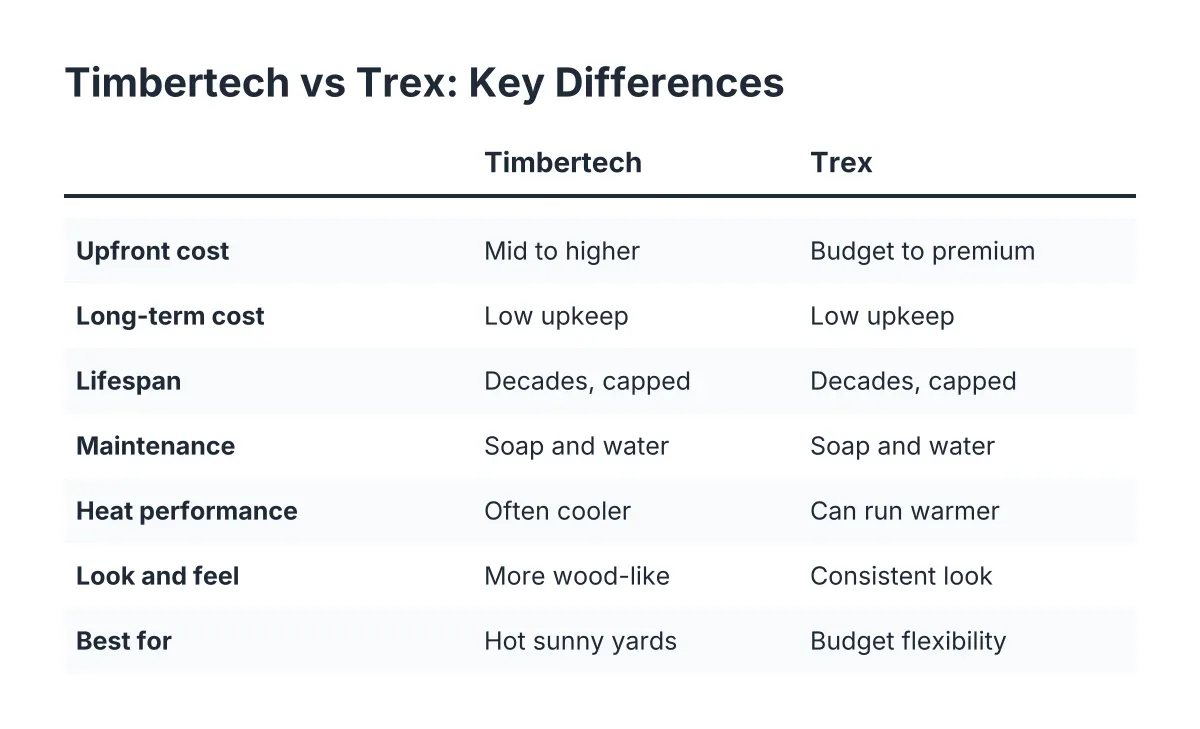
A fade and stain warranty is the manufacturer's written promise that the board's color will not fade beyond a stated amount and that common spills will not permanently stain it, for a set number of years. This is separate from any workmanship warranty your deck builder offers on the installation itself. Read the terms: warranties differ by brand and product line, which is part of why comparisons like TimberTech vs. Trex matter when you pick boards.
Linear Foot vs. Square Foot
A linear foot measures length along one line, while a square foot measures area, and deck quotes use both. Deck boards, fascia, and railing are often priced by the linear foot; the deck surface itself is usually priced by the square foot. Mixing the two up is the fastest way to misread a bid. When you compare quotes for composite deck installation, confirm every line uses the unit you think it does.
Using These Terms
What this composite decking materials glossary gives you is the vocabulary to read a deck quote the way a builder does: boards, fasteners, frame, and warranty, line by line. When a contractor mentions capstock or joist spacing, you now know whether it affects your scope, your cost, or both. Ask about anything a bid leaves out; a clear answer tells you as much as the number at the bottom.
If you need custom deck design, Inland Empire Decks can help.
Prefer to talk it through? Call (909) 298-8578 — a quick call is usually the fastest way to get a straight answer for your situation.